


Rajiv Gandhi International Stadium gives Hyderabad cricket a modern, high-energy venue away from the older city ground at Basheerbagh. The stadium is in Uppal, and many fans still call it Uppal Stadium during match talk. It became Hyderabad’s main international cricket venue in the 2000s and later grew into a strong IPL address.
The ground has a clear match personality. White-ball games can race ahead when the surface is flat. Fast bowlers need early accuracy because loose length disappears quickly. Spinners gain value when the pitch dries or slows. This mix keeps Rajiv Gandhi International Stadium Hyderabad interesting across Tests, ODIs, T20Is, and IPL nights.
Why Hyderabad Cricket Needed This Ground?
Hyderabad earlier staged major cricket at Lal Bahadur Shastri Stadium. The older ground had history, but the city needed a larger, dedicated cricket venue with modern facilities. The new stadium in Uppal gave Hyderabad its own international cricket base with practice areas, floodlights, media spaces, dressing rooms, and broader matchday facilities.
The move changed Hyderabad’s cricket map in three ways:
- International cricket shifted toward Uppal.
- Hyderabad domestic cricket gained a stronger base.
- IPL cricket gave the venue yearly visibility.
The stadium became part of the city’s sporting routine. Fans from Secunderabad, Uppal, Habsiguda, LB Nagar, Tarnaka, and central Hyderabad could now plan matches around a venue built for large cricket crowds.
Match Character of Rajiv Gandhi International Stadium
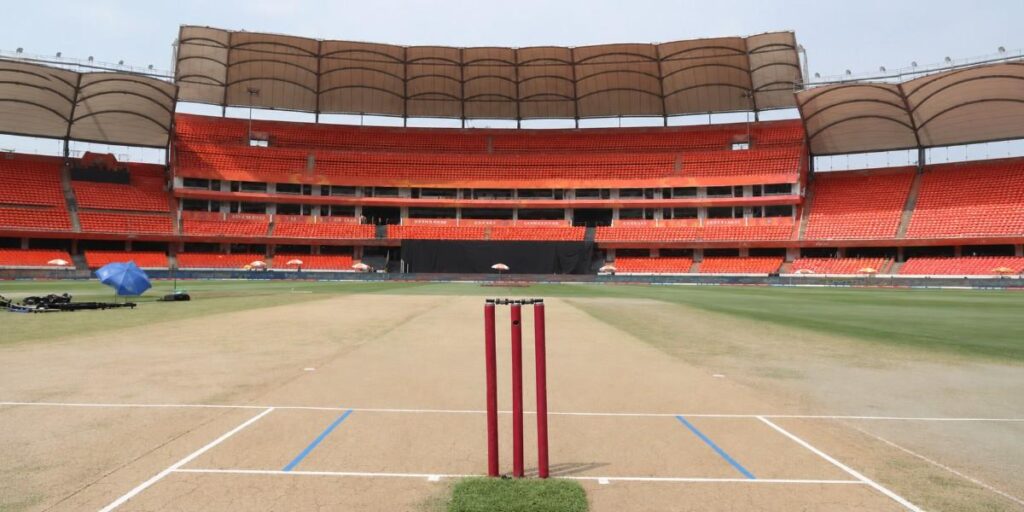
The Rajiv Gandhi International Stadium pitch report begins with batting value in most previews. The square has produced several high totals, and batters can score quickly once they trust the bounce. The outfield can give full value to timing, which helps set batters push the scoring rate.
The venue is not a one-note batting ground. Dryness can bring slower balls and spin into play. A surface with less pace can make stroke-making harder through the middle overs. This is why captains need to read the pitch before making toss decisions.
A simple match reading works well here:
- New-ball bowlers need a full, disciplined length.
- Batters can cash in after the first few overs.
- Spinners can attack when the surface grips.
- Slower balls can work during the final overs.
- Dew can change a night chase quickly.
- Fielding angles become important on a fast outfield.
T20 matches in Hyderabad can reward early intent, but careless hitting can still create a collapse. The ground gives value to batters who pick length early and bowlers who avoid predictable pace.
Capacity, Ends, and Venue Layout
Rajiv Gandhi International Stadium capacity is listed differently across venue references because cricket listings and facility descriptions use different counting methods. For regular cricket records, the match capacity is commonly placed around 38,000 to 39,200. Hyderabad Cricket Association facility descriptions have used a higher accommodation band for the venue.
The main bowling ends are:
- Pavilion End
- North End
The venue has floodlights mounted on six towers for day-night cricket. Its larger open setting gives it a different feel from compact older grounds. The stands can feel spread out, but a strong IPL crowd can still create a loud Hyderabad night.
Records That Explain the Ground Better
The Rajiv Gandhi International Stadium records show why the venue cannot be judged through one format. It has hosted long Test innings, high ODI totals, large T20I scores, and major IPL performances.
| Format | Key record | Detail |
| Test | Highest team total | India scored 687/6 declared against Bangladesh |
| Test | Low all-out total | West Indies were bowled out for 127 against India |
| ODI | Highest team total | Australia scored 350/4 against India |
| ODI | Low team total | England were bowled out for 175 against India |
| T20I | Highest team total | India scored 297/6 against Bangladesh |
| IPL | Highest venue total | Hyderabad’s IPL side scored 277/3 against Mumbai |
| IPL | Famous bowling return | Alzarri Joseph took 6/12 at this venue |
These records show the range of cricket played here. India’s 687/6 declared reflects long-format control. The 297/6 T20I total shows modern hitting power. The 277/3 IPL total confirms how quickly this venue can turn into a scoring ground when the pitch is true.
The IPL Identity of the Hyderabad Venue
The stadium is known across league cricket as the SRH home ground. Hyderabad’s IPL side has built many match nights around this venue, with orange shirts, loud stands, and heavy scoring phases giving the ground a clear league identity.
The Rajiv Gandhi International Stadium IPL records became a bigger search topic after the 2024 season. Hyderabad’s 277/3 against Mumbai brought the venue into modern T20 record conversations. Alzarri Joseph’s 6/12 in 2019 also remains a major IPL bowling mark from this ground.
IPL cricket here has a few clear patterns:
- Powerplay scoring can be rapid on true surfaces.
- Middle-over spin can slow a strong start.
- Death overs can change the final total sharply.
- Set batters can make the ground look small.
- Bowlers need variation rather than speed alone.
This venue suits teams with aggressive top-order batters and bowlers who can change pace late. A one-dimensional attack can struggle when the ball comes cleanly onto the bat.
International Cricket Milestones in Hyderabad
This Hyderabad cricket stadium has staged matches across all three international formats. The first ODI came in 2005, when India played South Africa. Test cricket arrived later, with India and New Zealand playing the venue’s first Test in 2010. The first T20I came in 2019, when India faced West Indies.
India’s 297/6 against Bangladesh in 2024 became the venue’s biggest T20I mark. The 2024 innings pushed Hyderabad further into the record conversation for high-scoring T20 cricket.
The ground has also hosted major World Cup cricket. During the 2023 ODI World Cup, matches in Hyderabad gave the stadium wider global visibility beyond IPL and India home fixtures.
Why Batters Like Hyderabad Conditions?
Batters enjoy Hyderabad when the pitch has pace and bounce. Straight hits carry well, and square shots can race away on a good outfield. A batter who survives early movement can score freely through the middle period.
The ground rewards three batting skills:
- Reading length early
- Hitting through the line
- Finding gaps during spin overs
Big scores here begin with control rather than blind hitting on strong batting days. Once a batter gets used to bounce, the scoring options open quickly. This is why Hyderabad can produce totals that look difficult at halfway but reachable during a strong chase.
Where Bowlers Can Still Fight Back?
Bowlers need patience at this venue. They cannot rely on one plan for twenty or fifty overs. A hard new ball may offer some movement, but the surface can become easier once batters settle.
The smarter bowling plans include:
- Full lengths with the new ball
- Pace change into the pitch
- Wider yorkers at the death
- Spin into the larger boundary
- Fielders placed for miscued power shots
Spinners can influence the match when the pitch grips. Fast bowlers can win short spells when they hit the deck hard or keep the yorker wide. The ground does not forgive loose overs for long.
Fan Notes Without the Usual Matchday Confusion
The Rajiv Gandhi International Stadium nearest metro station is Stadium metro station on the Hyderabad Metro Blue Line. It is the most practical rail access point for many fans heading toward Uppal on matchdays.
A simple visit plan helps:
- Reach early for India matches and IPL fixtures.
- Check the gate number before starting travel.
- Carry fewer items for smoother entry checks.
- Keep digital tickets and identity proof ready.
- Use metro travel when road traffic looks heavy.
The stadium area can get crowded near toss time. Arriving early gives fans better control over walking time, entry queues, and seating access.
Final Reading of the Hyderabad Stadium
Rajiv Gandhi International Stadium has become Hyderabad’s main cricket address because it combines modern facilities, league identity, and international record value. It has hosted Tests, ODIs, T20Is, IPL finals, World Cup fixtures, large totals, and standout bowling spells.
Its cricket personality is easy to understand. Batters can score fast when the surface plays true. Bowlers can still create pressure with discipline and pace changes. This balance gives the ground its value across formats.
FAQs
Who owns Rajiv Gandhi International Stadium?
Rajiv Gandhi International Stadium is owned and operated by Hyderabad Cricket Association. The venue serves Hyderabad cricket through domestic matches, international fixtures, league games, practice facilities, and major event operations.
Is Uppal Stadium the same as Rajiv Gandhi International Stadium?
Uppal Stadium and Rajiv Gandhi International Stadium refer to the same cricket venue in Hyderabad. Fans use Uppal because the ground is located in the Uppal area of the city.
What was the first international match at Rajiv Gandhi International Stadium?
The first international match at this venue was an ODI between India and South Africa in 2005. The stadium later hosted its first Test in 2010 and first T20I in 2019.
Which IPL finals were played at Rajiv Gandhi International Stadium?
The stadium hosted IPL finals in 2017 and 2019. Mumbai won the 2017 final against Pune. Mumbai defeated Chennai by one run in the 2019 final.
Which player has the best IPL bowling figures at this stadium?
Alzarri Joseph has the most famous IPL bowling return at this venue. He took 6/12 for Mumbai against Hyderabad in 2019, a spell still remembered for its shock value.