


The highest wicket taker in T20 World Cup history is Shakib Al Hasan. The Bangladesh left-arm spinner finished with 50 wickets from 43 matches, a number that still keeps him ahead of every other bowler in the tournament’s record book.
This record is not built on one hot tournament. Shakib played across several editions, handled different pitches, bowled in powerplays and middle overs, and gave Bangladesh control in matches where runs were hard to stop. His record has lasted because he combined accuracy, smart pace changes, and left-arm spin with long tournament experience.
The Answer Is Shakib Al Hasan
Shakib leads the T20 World Cup most wickets list with 50 wickets. His best tournament phase came in 2021, when he took 11 wickets and gave Bangladesh a strong spin option through the middle overs.
His overall record has three strong parts:
- He reached the 50-wicket mark in the tournament.
- He played in several editions from 2007 onward.
- He stayed useful across different conditions and team phases.
- He gave Bangladesh a wicket-taking option without leaking runs.
- He led the record table even after the 2026 edition.
For a format that changes quickly, Shakib’s record has rare length. Many fast bowlers have shorter peaks in T20 World Cups. Many spinners rise for one edition. Shakib stayed in the conversation across eras.
Career Wicket Table After the 2026 Edition
The most wickets in T20 World Cup history list is now tight behind Shakib. Adam Zampa and Adil Rashid have reached 44 wickets each. Rashid Khan is close with 43, and Jasprit Bumrah has moved to 40 after India’s 2026 title run.
| Rank | Bowler | Country | Matches | Wickets | Best Figures |
| 1 | Shakib Al Hasan | Bangladesh | 43 | 50 | 4/9 |
| 2 | Adam Zampa | Australia | 25 | 44 | 5/19 |
| 3 | Adil Rashid | England | 38 | 44 | 4/2 |
| 4 | Rashid Khan | Afghanistan | 27 | 43 | 4/9 |
| 5 | Jasprit Bumrah | India | 26 | 40 | 4/15 |
| 6 | Wanindu Hasaranga | Sri Lanka | 20 | 40 | 3/8 |
| 7 | Shahid Afridi | Pakistan | 34 | 39 | 4/11 |
| 8 | Anrich Nortje | South Africa | 21 | 38 | 4/7 |
| 9 | Lasith Malinga | Sri Lanka | 31 | 38 | 5/31 |
| 10 | Saeed Ajmal | Pakistan | 23 | 36 | 4/19 |
This table shows how much the record race has changed. Earlier lists were led by names such as Shahid Afridi, Lasith Malinga, and Saeed Ajmal. The current list has a heavy modern spin presence with Shakib, Zampa, Adil Rashid, Rashid Khan, and Hasaranga.
How Shakib Built a 50-Wicket Lead?
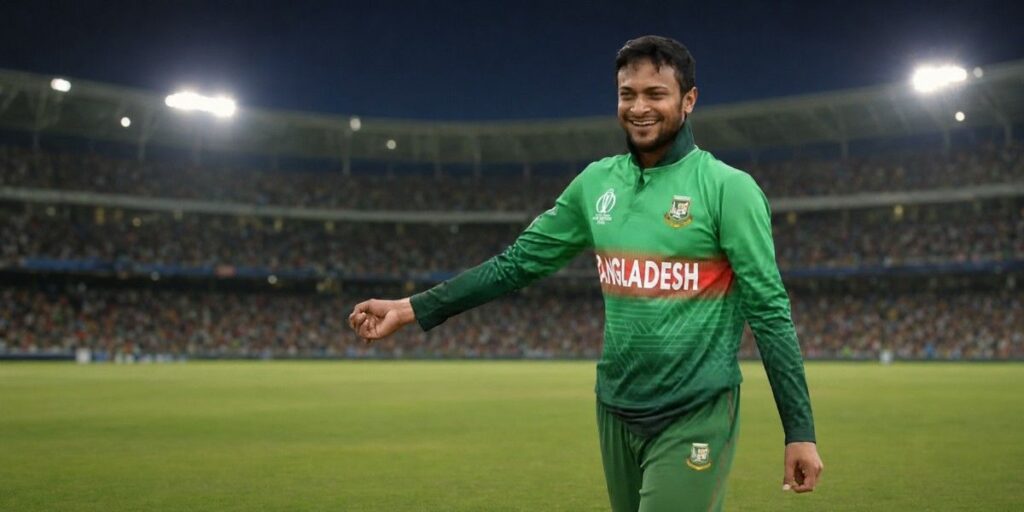
The Shakib Al Hasan T20 World Cup wickets record came from control, not raw mystery. He rarely needed extravagant turn. He changed pace, held a stump-to-stump line, and made batters hit against the field.
His bowling was useful because it suited different match points. In the powerplay, he could deny room. In the middle overs, he could force batters to take risks. Against lower orders, his straight line brought catches, bowled dismissals, and miscued hits.
Three qualities helped him stretch the record:
- He rarely wasted balls outside his plan.
- He understood batting panic in short chases.
- He used angles well against right-handers.
His record also reflects Bangladesh’s long use of him as a key bowler. He was not a part-time option. He carried main-bowler responsibility for many years.
The Bowlers Chasing the Record
Adam Zampa and Adil Rashid now sit closest to Shakib with 44 wickets each. Both leg-spinners have different styles, but both understand the middle-over job in T20 cricket.
Adam Zampa T20 World Cup wickets have come through direct leg-spin, quick overs, and strong control against attacking batters. He does not rely on sharp turn alone. He beats batters through length, pace change, and a clear plan at the stumps.
Adil Rashid T20 World Cup wickets have come through variation and flight. He makes batters wait, then drags them into high-risk shots. His value rises on surfaces where the ball grips, but he has also stayed useful on flatter pitches.
Rashid Khan T20 World Cup wickets stand at 43. His case is different because his strike rate and economy make him a threat even when batters play carefully. He bowls quicker through the air and gives batters little time to read the googly.
India’s Leading Names in the Record Race
Jasprit Bumrah now leads India’s list with 40 wickets. The India highest wicket taker in T20 World Cup debate shifted after his 2026 final spell, where he took four wickets and helped India win the title.
Bumrah’s record is valuable because he bowls the hardest overs. He takes the new ball, returns at the death, and still keeps his economy low. Many bowlers collect wickets when batters attack weak overs. Bumrah takes wickets when batters are trying to survive the best balls.
India’s main names in the tournament wicket list include:
- Jasprit Bumrah with 40 wickets
- Arshdeep Singh with 36 wickets
- Hardik Pandya with 33 wickets
- Ravichandran Ashwin with 32 wickets
- Axar Patel with 23 wickets
Arshdeep’s rise has been fast because left-arm angle and death-over courage suit T20 World Cup pressure. Hardik adds value through cutters, hard lengths, and overs when India need a sixth bowling option.
Single Edition Records Have Changed Quickly
The T20 World Cup 2026 highest wicket taker race ended with Jasprit Bumrah and Varun Chakaravarthy sharing the top place on 14 wickets. Bumrah played eight matches, while Varun played nine.
The single-edition record still belongs to Fazalhaq Farooqi and Arshdeep Singh, who took 17 wickets each in 2024. Wanindu Hasaranga had earlier held the major mark with 16 wickets in 2021.
A single-edition list rewards a different kind of skill:
- Form must arrive early.
- The team must play enough matches.
- Conditions must suit the bowler.
- Death overs can create extra wickets.
- Knockout matches can change the table quickly.
This is why career records and single-edition records should be read separately. A bowler can dominate one event without entering the all-time top five.
Why Spinners Own This Record Race?
T20 World Cups have given spinners a large role because middle overs decide many matches. Batters look for boundaries after the powerplay, and that creates chances for wrist-spin, left-arm spin, and defensive off-spin.
The leading list proves the pattern. Shakib, Zampa, Adil Rashid, Rashid Khan, Hasaranga, Afridi, and Ajmal are all spin bowlers. Each attacks differently, but the reason for their success is connected.
Spinners win in T20 World Cups through:
- Pace variation against set batters
- Boundary protection through clever fields
- Wicket chances during forced hitting
- Grip on slower surfaces
- Better matchups against middle-order batters
Fast bowlers still matter, but spinners get repeated chances when batters try to lift the scoring rate.
Why T20 World Cup Wickets Are Hard to Earn?
A wicket in this tournament carries weight because every batter knows the value of each ball. Unlike longer formats, batters do not need to protect an innings for hours. They attack matchups quickly and take chances early.
Bowlers need more than one skill. A pacer needs yorkers, slower balls, bouncers, and wide lines. A spinner needs pace change, length control, and courage to toss the ball up when the batter wants a boundary.
The hardest part is pressure. A bowler may get only four overs. One poor over can ruin the figures. A great spell needs accuracy from the first ball.
Final Word on the Record
The Highest Wicket Taker in T20 World Cup history remains Shakib Al Hasan with 50 wickets. His lead comes from long service, strong control, and a role that kept him central to Bangladesh’s bowling plans.
The chasing group is now strong. Adam Zampa, Adil Rashid, Rashid Khan, Jasprit Bumrah, and Wanindu Hasaranga have pushed the table forward. Bumrah’s 2026 climb gave India a new high point, while Zampa and Adil Rashid remain closest to Shakib’s record.
The record may change in future editions, but Shakib’s 50 wickets still stand as the mark every T20 World Cup bowler has to chase.
FAQs
What is bowling average in T20 World Cup records?
Bowling average means runs conceded per wicket. A lower average shows that a bowler took wickets without giving away many runs, which is valuable in short-format tournaments.
What does economy rate mean for T20 World Cup bowlers?
Economy rate means runs conceded per over. In T20 cricket, a low economy rate can pressure batters into risky shots, even when the bowler does not take wickets.
How many overs can a bowler bowl in a T20 World Cup match?
A bowler can bowl four overs in a standard T20 World Cup match. If rain reduces the match length, the bowling quota can be reduced under playing conditions.
Can a wicket on a no-ball count for the bowler?
A no-ball wicket does not count for bowled, caught, lbw, stumped, or hit wicket. A batter can still be dismissed through run out, obstructing the field, or handled-ball type dismissals under law.
Why do death-over bowlers take many T20 wickets?
Death-over batters take larger risks because few balls remain. Yorkers, slower balls, and wide lines can force mistimed hits, which creates catches near the boundary.