


If your question is how many substitute in football, five is the standard answer for most senior professional matches. Each team can normally use five replacements, although it must make those changes through no more than three opportunities while play is stopped. A substitution at half-time does not use one of the three opportunities.
The same principle answers how many substitutions in soccer. Even so, the final number always comes from the regulations for the match. Extra time, an adopted concussion protocol, an international friendly or an authorised lower-level format can change the allowance.
How Many Subs Can You Have in Football?
Law 3 permits organisers of official competitions to allow up to five substitutes per team. FIFA, the relevant confederation or the national association determines the number for each competition. Five is therefore the maximum available under the general provision, not a compulsory figure for every fixture.
Most leading men’s and women’s professional competitions use all five. Anyone checking how many subs are allowed in football should still read the applicable league or tournament regulations, since an organiser may set a lower limit or add provisions for extra time.
What Is the Difference Between Substitutes Used and Substitutes Named?
A substitute named is an eligible replacement listed on the team sheet. A substitute used is one who actually enters the field. Official competition rules may permit between three and fifteen named substitutes, but a larger bench does not create a larger playing allowance. A team may name fifteen replacements and still be allowed to use only five.
How Do Substitution Limits Compare Across Senior Football?
The senior football substitutions rules vary with the competition, even though five changes through three opportunities has become the familiar professional standard.
| Match type | Normal substitutes used | In-play opportunities | Additional provision |
| Premier League | 5 | 3 | Half-time does not use an opportunity |
| FIFA World Cup 2026 | 5 | 3 | A sixth change and another opportunity are available in extra time |
| UEFA club competitions | 5 | 3 | A sixth is available in knockout extra time |
| Other senior official competition | Up to 5 | Set by competition | The organiser confirms the final number |
| Senior A international friendly | 8 | 3 | Up to 11 by agreement, with the referee informed beforehand |
| Other friendly | Agreed by the teams | As agreed | Maximum 6 if the referee is not informed of an agreement |
| Youth or grassroots football | Competition-specific | Competition-specific | Return substitutions may be authorised |
Accordingly, the answer to how many substitutes in Premier League is five, used through three in-play opportunities. The answer to how many substitutes in football World Cup is also five in normal time, with an additional change and opportunity available if a knockout match reaches extra time.
Rules of Substitution in Football
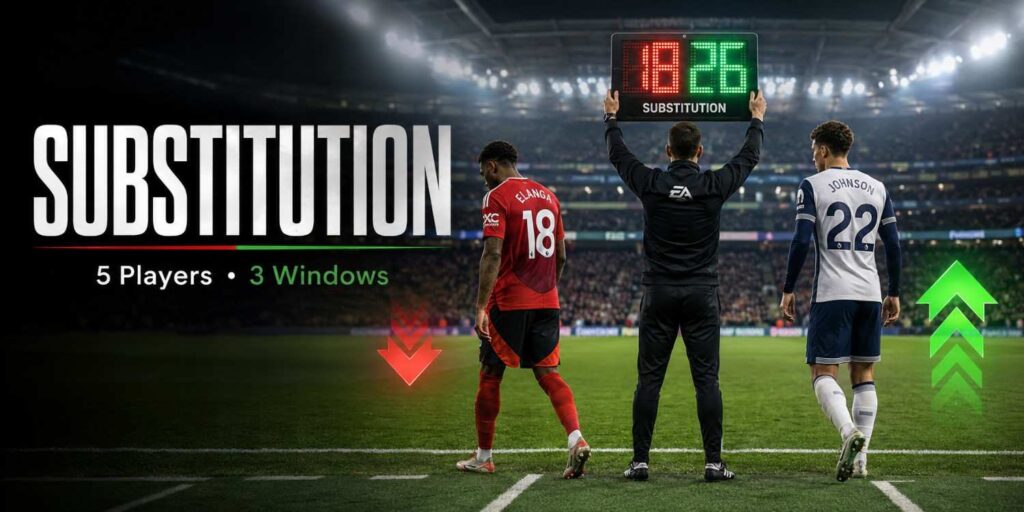
The referee controls every replacement, and the substitution is complete only when the incoming player enters the field. The normal sequence is:
- The team informs the referee or fourth official of the intended change.
- The substitution waits for a stoppage in play.
- The outgoing player receives permission to leave and normally uses the nearest boundary point, unless the referee directs the player elsewhere.
- The substitute waits at the halfway line until the outgoing player has left.
- The referee gives permission for the substitute to enter.
- The change becomes complete when the substitute enters the field. The substitute is then a player and may take the next restart.
What Is the 10-Second Exit Rule?
Under the 2026/27 procedure, the outgoing player should leave within ten seconds after the substitution is indicated. The referee can account for injury, safety or security circumstances that make a prompt exit impractical. If several players are leaving at the same stoppage, they must all leave within ten seconds of the final indication.
When a player exceeds the limit without a valid reason, play restarts before the substitute enters. The replacement then has to wait until the first stoppage after one minute of playing time has elapsed. The outgoing player is cautioned only if the delay becomes excessive, and the team cannot cancel the delayed substitution or nominate a different replacement.
How Do Five Substitutes Work Across Three Windows?
Within football substitution rules, an opportunity is one in-play stoppage at which a team makes one or more changes. Five available players do not create five separate chances to stop the match.
For example, one player entering in the 50th minute uses the first opportunity. Two players entering together in the 65th minute use the second, while two more entering together in the 80th use the third. The team has now made five substitutions through three opportunities.
Several changes by the same team at one stoppage count as one opportunity. If both teams make changes during that stoppage, each team uses one of its own opportunities. A half-time replacement remains separate and does not reduce the three-opportunity allowance.
When Can a Team Make More Than Five Substitutions?
What Changes When a Match Goes to Extra Time?
A competition may permit one additional substitute when a knockout match enters extra time. Any unused normal-time substitutes and opportunities carry forward, while the extra-time provision adds another player and another opportunity. Changes made between full-time and extra time, or at the interval in extra time, do not use an opportunity.
Suppose a team has used four substitutes and all three normal-time opportunities. It carries the unused fifth substitute into extra time. If the competition also permits a sixth, the team has two replacements left and receives one further in-play opportunity in which to use them.
How Do Permanent Concussion Substitutions Work?
A competition may adopt the additional permanent concussion substitution protocol. Where it applies, each team may use a maximum of one such replacement. It does not count towards the ordinary substitute allowance or the usual opportunities, and the removed player cannot return, including for a penalty shoot-out.
When one team uses the protocol, its opponent receives an additional substitute and an additional opportunity that may be used for any reason. An ordinary injury, muscle problem or case of fatigue does not trigger this medical provision.
Can a Substituted Player Return to the Match?
What Applies in Senior Professional Football?
An ordinary substitution is permanent in senior professional football. Once the replacement enters with the referee’s permission, the departing player becomes a substituted player and cannot return later in the fixture.
When Are Return Substitutions Allowed?
Youth, veterans, disability and grassroots competitions may authorise return substitutions. The relevant association or competition must approve the arrangement. Re-entry is not available merely because the teams agree that it would be convenient.
Does a Red Card Create Another Replacement?
No. A player sent off after kick-off cannot be replaced, even if the team still has unused substitutes. If the goalkeeper is dismissed, the team may use an ordinary substitution to bring on a reserve goalkeeper for an outfield player, but it still continues with ten players. If no substitution remains available, one of the remaining outfield players must take over in goal.
Only named substitutes may enter. A substituted senior player cannot return, a substitute who is sent off cannot be replaced, and every bench player remains under the referee’s authority. Unused replacements never remove the numerical effect of a red card.
Also read: Which Cricketer Has More Fans: Fanbase Ranking and Real Reasons
Football Substitution Rules 2025 vs 2026/27
The five-player framework has not changed, but the 2026/27 laws alter two practical details. Senior A international friendlies now allow eight substitutes, or up to eleven when the teams agree and inform the referee in advance. The ten-second exit procedure is also new.
| Rule area | 2025/26 position | 2026/27 position |
| Senior official competitions | Up to 5 | Up to 5 |
| Normal in-play opportunities | 3 when five substitutes are allowed | 3 when five substitutes are allowed |
| Half-time changes | No opportunity used | No opportunity used |
| Senior A international friendlies | Maximum 6 unless a higher number was agreed and reported | 8; up to 11 by prior agreement |
| Concussion replacement | Competition option | Remains a competition option |
| Player exit procedure | Nearest boundary point, subject to the referee’s direction | Ten-second limit, subject to recognised exceptions |
What Is the Final Rule on Football Substitutes?
For anyone asking how many substitute in football, five is the normal answer in major professional competitions. Those changes usually have to fit within three opportunities during play, while half-time remains additional. Before relying on that total, check the match regulations for extra time, concussion replacements, friendly-match agreements and authorised lower-level variations.
FAQs About Football Substitutions
Can a goalkeeper be substituted during a football match?
Yes. A goalkeeper can be replaced like any other player. An outfield player may also exchange positions with the goalkeeper during a stoppage, provided the referee is informed before the change.
What happens if a player refuses to be substituted?
The referee does not force the player to leave simply because the manager has requested a change. Play continues, although separate misconduct such as dissent or deliberate delay can still be punished.
Can a substituted player take part in a penalty shoot-out?
Ordinarily, no. A player removed during the match cannot return for the shoot-out. Eligibility normally belongs to players on the field, or temporarily off it, when the match ends. A separate exception may allow an eligible substitute to replace a goalkeeper who becomes unable to continue, provided the team still has a permitted substitution available.
Can a substitute receive a red card without entering the field?
Yes. Named substitutes remain under the referee’s authority. Misconduct on the bench or while warming up can result in a yellow or red card.
Can a starting player be replaced before kick-off?
Yes. A named substitute may start in place of a listed player. The referee must be informed, the original player may become a named substitute, and the standard in-match allowance is not reduced.